
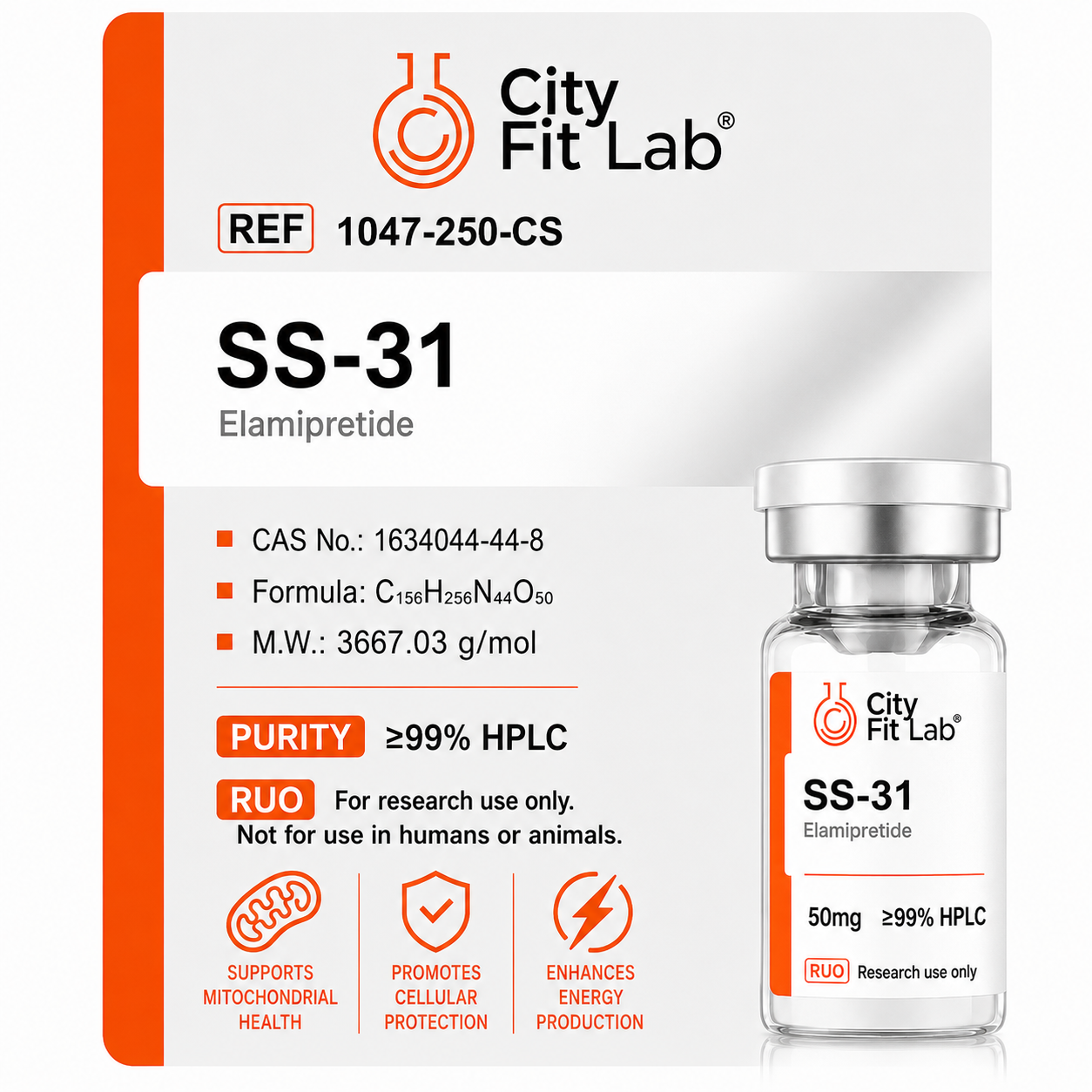
SS 31 50mg
SS31 (Elamipretide) is a mitochondria-targeted research peptide designed to study mitochondrial function, cellular energy pathways, and oxidative biology. It has attracted interest in scientific research focusing on mitochondrial membranes, energy metabolism, and cellular performance mechanisms. The unique structure of SS31 makes it a valuable compound for researchers investigating mitochondrial-related biological processes and peptide-based approaches in cellular science.
- Estimated Delivery : Up to 4 business days
- Free Shipping : On all orders over $2000 MXN
▎SS31 Structure

Source: PubChem |
Sequence: RXKF
Molecular Formula: C32H49N9O5 Molecular Weight: 639.8g/mol CAS Number: 736992-21-5 PubChem CID: 11764719 Synonyms: Elamipretide |
▎SS31 Research
What is the research background of SS31?
SS31 is a water-soluble, aromatic cationic, mitochondria-targeted tetrapeptide (Sabbah H N, 2022). Its unique chemical structure enables it to easily penetrate and transiently localize to the inner mitochondrial membrane. Specifically, it can bind to cardiolipin, a major component of the inner mitochondrial membrane, thereby exerting its effect of improving mitochondrial function.
This distinctive chemical structure provides a foundation for its application in the treatment of various diseases. Many diseases are associated with mitochondrial dysfunction, such as Barth syndrome, heart failure, neurodegenerative diseases, etc. Mitochondria play a crucial role in cellular energy production, regulation of oxidative stress, and other aspects. When mitochondrial function is impaired, it can lead to problems such as insufficient cellular energy, increased oxidative stress, and neuroinflammation, which in turn trigger various diseases.
The research and development of SS31 aim to target these mitochondrial-related diseases, alleviating disease symptoms by improving mitochondrial function and enhancing patients’ quality of life and survival rate. With the continuous in-depth research on mitochondrial biology, people have gradually recognized the importance of mitochondria in the occurrence and development of diseases.
Researchers have found that mitochondrial dysfunction is closely related to the pathophysiological processes of various diseases. For example, in neurodegenerative diseases, there are issues such as neuronal mitochondrial dysfunction, chronic neuroinflammation, accumulation of toxic proteins, and neuronal apoptosis[1]. Before entering clinical research, SS31 underwent extensive preclinical studies. These studies included experiments conducted on cell models and animal models to evaluate the safety, efficacy, and pharmacokinetic properties of the drug. For instance, in the study of Barth syndrome, SS31 demonstrated the ability to rapidly improve mitochondrial bioenergetics and morphology in induced pluripotent stem cell models[2].
In the research on neurodegenerative diseases, SS31 has shown neuroprotective effects in multiple animal models, including enhancing mitochondrial respiration, inhibiting neuroinflammation, and preventing the accumulation of toxic proteins[1]. SS31 has already been involved in several clinical studies covering different disease areas.
In the treatment of heart failure, a randomized, placebo-controlled trial showed that a single infusion of SS31 is safe and well-tolerated, and a high dose of SS31 can improve left ventricular volume, supporting its potential role in the treatment of heart failure[3].
What are the specific mechanisms of action of SS31 in different disease models?
1. Mechanism of action in the model of hemorrhagic shock and aortic balloon occlusion
In the model of ischemia-reperfusion injury (IRI) caused by hemorrhagic shock and aortic balloon occlusion (REBOA), mitochondrial damage plays a central role. SS31 can reduce the demand for crystalloid fluid and protect the kidneys and heart. Specifically, it can lower the concentrations of serum creatinine, troponin, and interleukin-6, but it has no effect on the final plasma lactate concentration. SS31 may alleviate IRI by protecting mitochondria, opening up new treatment avenues for patients suffering from IRI after bleeding[4].
2. Mechanism of action in Barth syndrome
Barth syndrome is a rare X-linked disorder characterized by cardiomyopathy, skeletal muscle weakness, growth retardation, and cyclic neutropenia. SS31 is a water-soluble, aromatic cationic, mitochondria-targeted tetrapeptide that can penetrate the outer mitochondrial membrane and bind to cardiolipin. It promotes cell health by improving energy production and inhibiting the excessive formation of reactive oxygen species, thereby reducing oxidative stress. In induced pluripotent stem cells of Barth syndrome and other genetically related diseases characterized by childhood cardiomyopathy, SS31 can rapidly improve mitochondrial bioenergetics and morphology. The results of multiple studies support the use of SS31 as a potential treatment for patients with Barth syndrome, especially in cases where cardiomyopathy has been diagnosed[2].
3. Mechanism of action in autosomal dominant polycystic kidney disease (ADPKD)
Pregnancy is considered to exacerbate the progression of cysts in autosomal dominant polycystic kidney disease (ADPKD). However, tolvaptan, the only drug approved by the FDA for adult ADPKD, is not recommended for pregnant ADPKD patients due to the potential harm to the fetus. SS31 is a mitochondria-protective tetrapeptide that has been found to improve the progression of kidney disease in pregnant Pkd1RC/RC mice, while reducing ERK1/2 phosphorylation and improving the formation of mitochondrial supercomplexes. In addition, SS31 can cross the placenta and breast milk, improving aggressive infantile polycystic kidney disease without any observed teratogenic or harmful effects. These preclinical studies support the potential clinical trials of SS31[5].
4. Mechanism of action in heart failure
In heart failure (HF), negative changes in mitochondria are known to occur. SS31 has a positive impact on the mitochondrial and supercomplex functions of human heart failure. It can significantly increase the oxygen flux, complex I and complex IV activities, and complex IV activity associated with supercomplexes in weakened human heart mitochondria, significantly improving human mitochondrial function failure [6].
In children with single ventricle congenital heart disease (SV CHD), the clinical indications for heart transplantation suggest the presence of mitochondrial dysfunction. SS31 is a pentapeptide targeting cardiolipin that can improve the interaction of mitochondrial supercomplexes (complex I, III, IV). In the hearts of children with SV CHD, SS31 can improve complex I activity and maximum respiration (MR), suggesting that it mainly exerts its effect by improving mitochondrial supercomplexes [7].
5. Mechanism of action in diabetic nephropathy
In the db/db mouse model of type 2 metabolism, diabetic nephropathy (DKD) is associated with a decrease in renal and cardiac superoxide levels. The mitochondria-protective agent SS31 (also known as MTP-131, SS31, or Bendavia) can significantly inhibit the increase in proteinuria, urinary H₂O₂, and glomerular mesangial matrix accumulation in db/db mice, and completely preserve the renal superoxide production levels in these mice. SS31 can also reduce the total renal lysocardiolipin and the main lysocardiolipin subclasses in db/db mice, and preserve the expression of lysocardiolipin acyltransferase 1. These results indicate that in type 2 metabolism, DKD is associated with a decrease in renal and cardiac superoxide levels, and SS31 may protect against DKD and preserve physiological superoxide levels by regulating cardiolipin remodeling [8].

The hypothesized diagram summarizes the neuroprotective effects of elamipretide on neural mitochondria quality-control.
Source:PubMed[1]
What are the related applications of SS31?
Cardiomyopathy in Barth syndrome: Barth syndrome is a rare and potentially life-threatening X-linked disorder characterized by cardiomyopathy, skeletal muscle weakness, growth retardation, and cyclic neutropenia. Patients have a high risk of death in infancy and are prone to developing cardiomyopathy accompanied by a severe weakening of the immune system. SS31 presents both challenges and opportunities for the treatment of cardiomyopathy in patients with Barth syndrome. The results of multiple studies support its use as a potential treatment for patients with Barth syndrome, especially when cardiomyopathy is diagnosed. It may have a lasting impact on the progression of cardiomyopathy and gradually and structurally reverse the remodeling of the failing left ventricle at the global, cellular, and molecular levels[2].
Single ventricle congenital heart disease:
Congenital heart disease is the most common birth defect, and severe single ventricle congenital heart disease is the main indication for infant heart transplantation, with very few medical treatment options currently available. It has been found that there is mitochondrial dysfunction in the hearts of children with single ventricle congenital heart disease, and the mitochondria-targeted peptide SS31 can improve the mitochondrial function of the heart. Further research on the ability of this drug to improve myocardial function and delay the progression of transplantation is necessary[7].
Leber’s hereditary optic neuropathy:
A study evaluated the safety, tolerability, and potential efficacy of topical use of SS31 in the treatment of patients with Leber’s hereditary optic neuropathy. The results showed that SS31 was well-tolerated, but did not reach the primary visual efficacy endpoint. However, the evaluation of visual function during the open-label extension period and the post-hoc analysis showed encouraging improvements in the mean deviation of the central visual field, which requires further exploration [9].
Traumatic optic neuropathy:
It has been found that SS31 (MTP-131), a mitochondria-targeted small molecule tetrapeptide, when used in combination with the tumor necrosis factor inhibitor etanercept, can serve as a neuroprotectant for retinal ganglion cells after optic nerve trauma in mice. Subcutaneous etanercept or MTP-131 alone and their combination can all increase the survival rate of retinal ganglion cells, but no synergistic effect was observed when they were used in combination[10].
Spinal cord injury: SS31 (SS31) is a novel aromatic cationic peptide that can freely cross the blood-brain barrier. Studies have shown that SS31 promotes functional recovery after spinal cord injury by inhibiting cPLA2-mediated autophagic damage, preventing an increase in lysosomal membrane permeability, and inhibiting pyroptosis, and it has potential clinical application value[11].
Neuroinflammation and cognitive impairment:
In aged rats, lipopolysaccharide can induce systemic inflammation and neuroinflammation, and SS31 can be used for treatment. Studies have shown that inhibiting hippocampal neuroinflammation can not only reduce the inflammatory response in the hippocampus but also improve the functional connectivity of the brain in hippocampus-related regions. Early anti-inflammatory treatment with SS31 has a lasting effect on reducing the impact of lipopolysaccharide-induced neuroinflammation[12].
Autosomal dominant polycystic kidney disease:
Pregnancy is considered to exacerbate the progression of cysts in autosomal dominant polycystic kidney disease. It has been found that the mitochondria-protective tetrapeptide SS31 can improve the progression of kidney disease in pregnant Pkd1^{RC/RC} mice, while reducing ERK1/2 phosphorylation and improving the formation of mitochondrial supercomplexes. SS31 can cross the placenta and breast milk, improving severe infantile polycystic kidney disease without any observed teratogenic or harmful effects [5].
Neurodegenerative diseases:
SS31 is a mitochondria-targeted small molecule tetrapeptide that has shown therapeutic effects and safety in various mitochondrial-related diseases. In neurodegenerative diseases, SS31 can enhance mitochondrial respiration, activate neuronal mitochondrial biogenesis through mitochondrial biogenesis regulators and translocator factors, enhance mitochondrial fusion, inhibit mitochondrial fission, increase mitophagy, reduce neuronal oxidative stress, neuroinflammation, and the accumulation of toxic proteins, prevent neuronal apoptosis, and enhance neuronal survival pathways. Therefore, SS31 may prevent the progression of neurodegenerative diseases by enhancing mitochondrial respiration, biogenesis, fusion, and neuronal survival pathways, as well as inhibiting mitochondrial fission, oxidative stress, neuroinflammation, the accumulation of toxic proteins, and neuronal apoptosis[1].
Sarcopenia: It has been found that 8 weeks of treatment with SS31 can partially reverse the age-related changes in protein phosphorylation in the skeletal muscles of aged female mice, which is consistent with the improvement of skeletal muscle function and the restoration of changes in protein S-glutathionylation [13].
As a mitochondria-targeted drug, SS31 provides an innovative strategy for the treatment of mitochondrial diseases. By protecting the structure and function of mitochondria, it has demonstrated clinical value in diseases such as LHON and Barth syndrome, especially showing significant efficacy in acute optic neuropathy. It has a therapeutic effect on various diseases associated with mitochondrial dysfunction, such as heart failure and neurodegenerative diseases, and can relieve symptoms and delay the progression of the disease.


Reviews
There are no reviews yet.